










A Call to Action: AACC’s New Leadership and Report Inspire a Resilient Future for Community Colleges

by

Resilient by design report cover

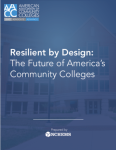
Released on the same day that Dr. DeRionne P. Pollard assumed the role of president and CEO of the American Association of Community Colleges (AACC), the report Resilient by Design: The Future of America’s Community Colleges offers a timely reflection on the challenges and opportunities shaping two-year academic institutions. Describing the 64-page report as “a mirror, a map, and a call to action,” Pollard invites community college educators and leaders to embrace transformation through collaboration, innovation, and data-informed strategy.

Prepared by the National Center for Higher Education Management Systems (NCHEMS) on behalf of AACC, the report examines the dynamic pressures facing community colleges. Drawing on surveys, interviews, and research, Resilient by Design outlines how demographic shifts, declining enrollment rates, rapid technological changes, evolving workforce demands, differing student expectations, and broader economic and political forces are reshaping the landscape of higher education. However, the report frames these pressures as opportunities to innovate, collaborate, and rethink how colleges deliver on their mission of access, adaptability, and workforce development.

» Read More or Comment

Podcaster Peter Kazarinoff Has Technicians Tell Their Stories to Help Others Find Careers

by

Peter Kazarinoff recording a podcast

Seven years ago as a member of the team developing the Advanced Technological Education (ATE) grant proposal for the Micro Nano Technology Education Center (MNT-EC), Peter Kazarinoff suggested requesting funds for podcasts that would feature semiconductor technicians talking about their careers.

Kazarinoff said he thought it was important for working technicians to share their stories “so that other community college faculty can hear what those working technicians do. And then other community college students can hear what they might be doing once they graduate because there aren't a whole lot of alumni stories out there about technicians that work in the semiconductor industry.”

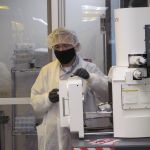
He pointed out that because semiconductor factories, which are called fabs, are closed environments due to the sensitivity of equipment and intellectual property most people do not know how they operate.

When Kazarinoff was interviewed for the ATE Impacts Blog in early October he had just completed his 59th interview for Talking Technicians, which is in the midst of its sixth 12-episode season for MNT-EC.

He continues to be impressed by the “life transformations” that have happened as a result of people becoming technicians. Kazarinoff explained that he always asks the people he interviews, “How did your life change when you became a technician?

“And the answers to that question have just been illuminating and inspiring and make me want to keep working as a community college faculty member and working on MNT-EC and recording more episodes.

» Read More or Comment

Redefining Lifelong Learning: Strategies to Support Older Students in Higher Education

by

Image of older learners

In an era of evolving industry demands and demographic shifts, people are living and working longer, extending opportunities for new and continuous education later in life.

Older learners, defined as those ages 35 and older, are becoming increasingly common in the post-secondary landscape. A recent report from Inside Higher Ed, supported by AARP, outlines the need for colleges and universities to adapt to the growing prevalence of older students. It notes that creating viable pathways for these learners can support economic growth, workforce development, and social engagement. Calling them “Generation Now,” older adults bring a unique set of assets to education, including a variety of lived experiences, intrinsic motivation, and focused goals spanning from career advancement to making a difference in the world.

» Read More or Comment


ATE Impacts is also a book! Copies are available upon request or at the annual ATE PI Conference in Washington, DC.

ATE Impacts also has a video series, that tells the stories of students, educators, administrators, and industry partners who have had their lives positively impacted by the work of the ATE program.
Have an ATE story to tell?
Email us at impact@ateimpacts.net
Creative Commons License The ATE Impacts blog is licensed under a Creative Commons Attribution-ShareAlike 4.0 license. You are free to share, copy, distribute, transmit, and adapt this work, provided you attribute it to the Internet Scout Research Group. If you alter this work, you may distribute your altered version only under a similar license.